Guide
Types of charging stations: AC and DC, connectors and power explained
Type 2, CCS, 22 kW, 150 kW: the labels on a charger tell you how fast your car will charge and which cable to use. Here is what they mean.
AC chargers: the everyday ones
Alternating-current chargers are the wallboxes and the posts in car parks, on the street, at hotels, offices and shops. The power goes from 3.7 kW to 22 kW, and it is the car's on-board charger that converts it for the battery: many cars accept 7.4 or 11 kW at most, so a 22 kW post does not charge them faster. A full charge takes from a few hours to a night, which is why AC is the right choice where the car is parked anyway. The price per kWh is usually the lowest.
DC chargers: fast and high power
Direct-current chargers convert the power themselves and feed the battery directly, from 50 kW up to 350 kW and more. They are the ones at service areas and along main roads, built for a stop of twenty to forty minutes. The car charges fast until about 80% and then slows down. The price per kWh is higher, because the equipment and the power connection cost more.
Connectors in Europe
Type 2 is the AC connector of every car sold in Europe; on public posts you usually bring your own cable, while wallboxes often have a tethered one. CCS (Combo 2) is the DC connector: the same shape as Type 2 with two extra pins, and the charger's cable is always attached. CHAdeMO is an older DC standard still used by some models, less and less common on new chargers. A Tesla charges with Type 2 and CCS like any other car.
Reading the socket in the app
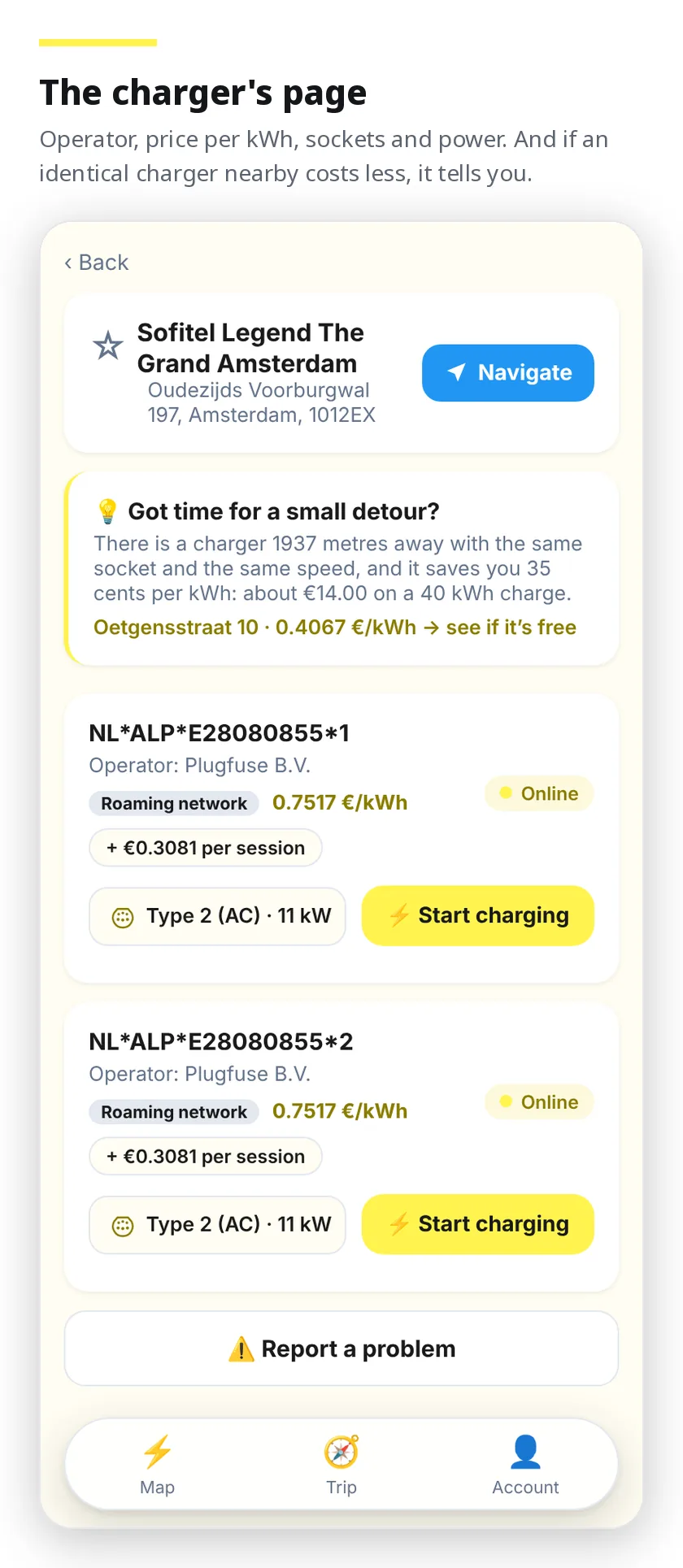
Every socket in the Taac! app shows its connector, its maximum power, whether it is free and its price per kWh before you start. You filter the map by connector, power and operator, and with your car in the Garage the app never promises more power than the car accepts: a Tesla on alternating current stops at 11 kW, and the estimate says so. For a stop of several hours choose AC; on a trip, DC.
Frequently asked questions
Can I charge a 7 kW car at a 22 kW post?
Do I need my own cable?
What is the difference between kW and kWh?
Is a more powerful charger always better?
Charge with Taac!, no subscription
One app for the Taac! network and the chargers of other operators in twenty-five countries. The price is on every socket before you start; you pay the kWh you receive, with a receipt in your history.