Guide
Charging on the motorway: fast chargers, Ionity and how to stop less
High-power chargers at service areas are the ones that make long trips possible. Here is how they work, how long a stop takes and how to use Ionity with Taac!
What a high-power charger is
On the motorway you find direct-current (DC) chargers from 50 kW up to 350 kW and beyond. The car's own battery decides how fast it charges: a car that accepts 100 kW gets 100 kW even from a 350 kW charger. The speed also drops as the battery fills, which is why on a trip you charge from about 10% to 80% and leave: the last 20% can take as long as the first 70%.
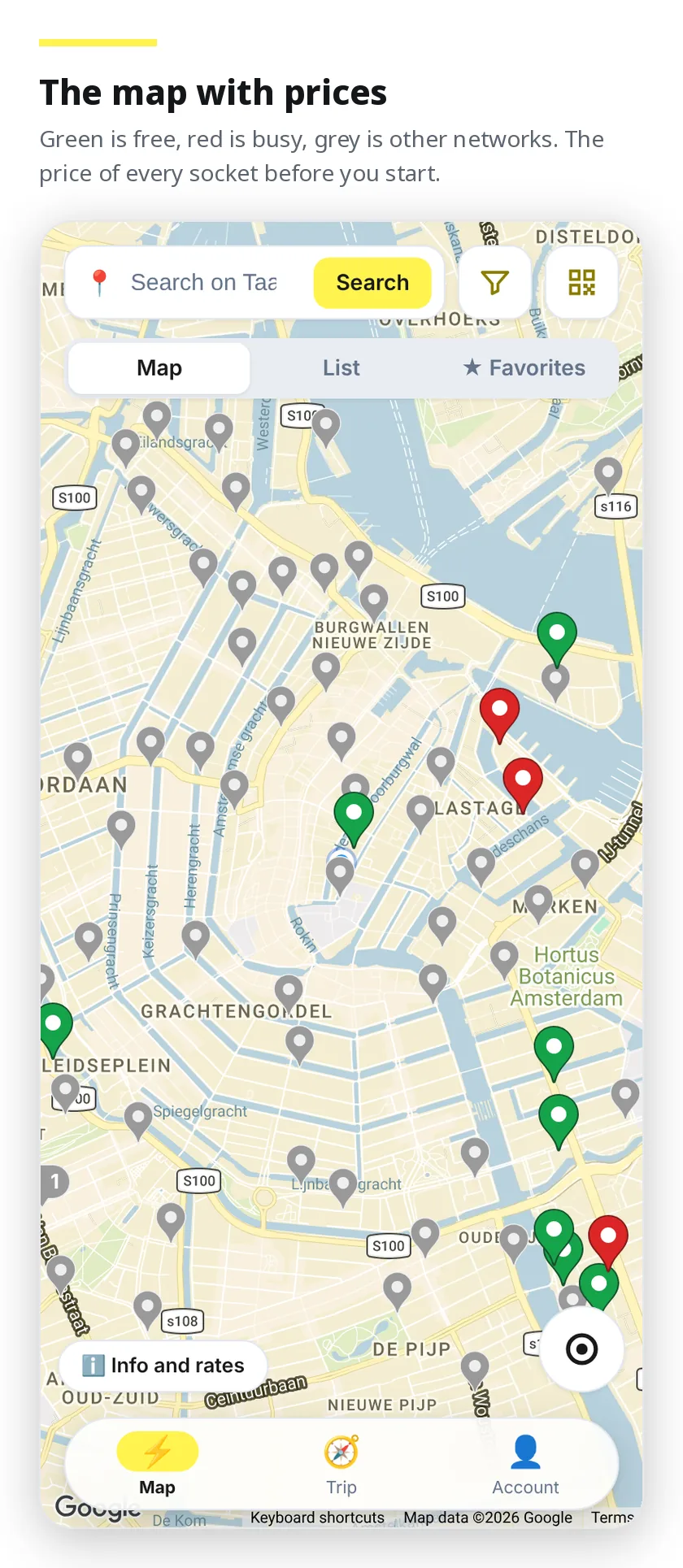
A stop at a high-power charger usually lasts between twenty and forty minutes. In the app you filter the map by power and connector, see which stalls are free and the price per kWh of each socket before you leave the motorway.
Ionity with Taac!
Ionity runs high-power chargers along the main European routes. With Taac! you can charge at Ionity in twenty-one countries, with the same account, the same payment and the same receipt as on any other charger: no Ionity subscription and no card. The price per kWh of Ionity in each country is on the price list page and in the cost guide, and on every socket in the app.
On the map you also see Tesla Superchargers, with the number of stalls and whether they are open to every car. You see them and you can navigate to them; you do not pay for them with Taac!
What a motorway charge costs
High-power charging costs more per kWh than a slow charger in town, because the equipment and the power connection are expensive. Some operators add a fee per minute after a certain time, or an idle fee if you stay plugged in after the end: both are on the socket's page in the app. For the cheapest trip, charge at home before you leave, use the motorway chargers only for what you need to reach the next stop, and finish on a cheaper AC charger at your destination.
Plan the stops before you leave
The trip planner in the app takes your starting point, your destination and your car from the Garage, and proposes the charging stops with the time and the kWh for each one. Along the way you can follow a socket and be told when it frees up, and book one, where the charger allows it, for the fifteen minutes it takes you to get there.
Frequently asked questions
Do I need a special card for Ionity?
Why does my car not charge at the power written on the charger?
What happens if I stay plugged in after charging ends?
Is it better to charge to 100% on the motorway?
Charge with Taac!, no subscription
One app for the Taac! network and the chargers of other operators in twenty-five countries. The price is on every socket before you start; you pay the kWh you receive, with a receipt in your history.